

From Engineers to Playwrights: The Remarkable Founders of Greville Lodge
As presented by Frank Collier, Lodge Archivist, at the presentation of the centenary warrant, Thursday 15th January, 2026.
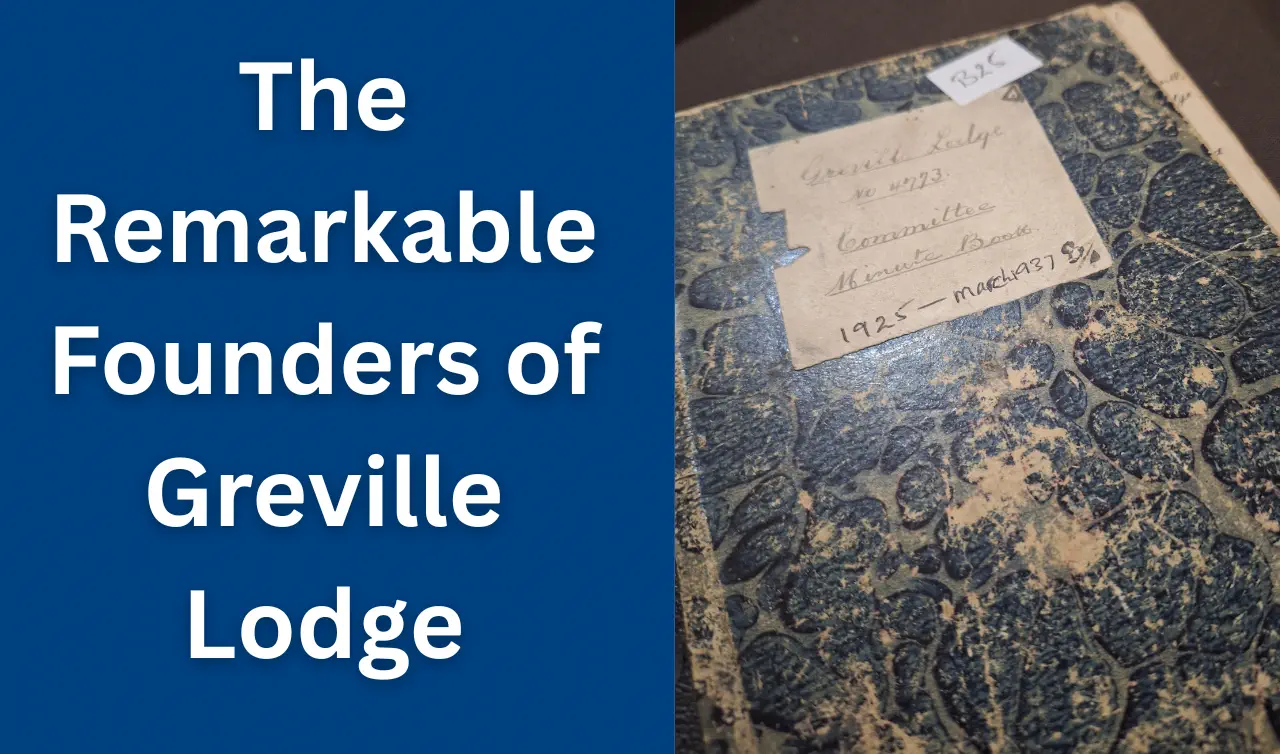
The original minute book for Greville Lodge records the first regular meeting held over 100 years ago on Friday 15th January 1926. The Lodge at that time held its meeting on a Friday – changed to Thursdays in 1928.
It lists the notable original members and founders of the Lodge. This ties in well with the current profile of the Lodge highlighting the fact that Greville Lodge prides itself on taking members from all walks of life and professions. As I hope you will see from the following:
The original members of the Lodge were:
Harold Booth Mason –Engineer, Born Warwick 1894 IPM
Mayor of Warwick 1910 – 1911. Obviously public spirited he served in both world wars.
London Gazette Dated 24th October, 1914: Captain (temporary), 7th Battalion, The Royal Warwickshire Regiment;Gazetted again in January 1941 to Major in the RASC aged 47.
Bernard Rogers Knight, First Master of the Lodge
Born Liverpool 1877, 2 St Johns, Warwick
His occupation in the book of declarations is listed as a Shirt Builder,and an entry in the Leamington Courier in 1930 shows the following advertisement: “B Rogers Knight, Tailor, Hosier and Shirt Builder. Special Gown displays at 168 and 124, The Parade, Royal Leamington Spa and also Stratfor upon Avon. Pure Wool slippers, ladies and gents 6/9d per pair.”
Further research revealed that the title of “Shirt Builder” was introduced during the Victorian Period when mechanical manufacturing practices were introduced. This meant that each garment (shirt) did not have to be cut individually from a pattern by hand but could be cut, several at a time, by machine, to a standard pattern and then sewn by hand with a sewing machine. In order to preserve and protect the bespoke tailoring trade this system was known as “Shirt Building”.
Arthur Henry Measures, Work House Master. Secretary
It may come as a surprise to find that Workhouses were still in existence in the early 20th Century. I know from my own family history, my maternal grandfather and great grandfather were “Workhouse Masters and the Poor Laws, whilst much amended continued to be in force until the introduction of the National Health Service and Social Services in the 1940’s
Arthur and his wife Ethel, suffered tragedy in the 2nd world war. Their 2 sons, George Frederick and Herbert Thomas Measures were both killed in action.
The death of Herbert, Second Lieutenant, King’s African Rifles, must have been especially difficult as they had not seen him for a number of years. He was educated at Warwick School, and upon graduation from Oxford University he moved to Trinidad where he became a tropical agriculturist. He was then posted to Kenya under the Colonial Office where he enlisted and obtained a commission. Died on Sunday 27 July 1941, aged 26 and is buried in the Addis Ababa War Cemetery. Both sons are commemorated on the Town’s war memorial.
Arthur was Secretary of the lodge and the LOI for 18 yearsand during the same period found time to write a “Visitors Guide To Warwick” which is still in print.
Ernest Frederick HaddowH M Coroner for Warwickshire. DC
Born Leicester 12 April 1869. 6 Beauchamp Ave, Leamington Spa. He married Annie Hughes in 1906 and moved into “Streatley”, South Bank Road, Kenilworth with an elderly aunt, cousin and 2 domestic servants. By 1939 he was widowed and living at the Beauchamp Ave address. A member of Shakespeare Lodge – initiated in 1915.
George Edgar Evemy Motor Engineer Senior Warden
Born London 1877. Aged 18 he enlisted in the 15th Hussars and served in the Boer War. Initiated into Panmure Lodge 720, London 1913.
By the 1939 Census he was a Funeral Director and Carriage Owner based in Leamington.
Charles Watson Mill Dramatic Author Junior Warden
Charles Watson Mill was born in 1874 in Leamington Spa. During his early years he developed a love of the theatre, and from the early twentieth century became a well-known playwright, actor, and theatrical producer. In 1910 he took the tenure for the Theatre Royal, Leamington Spa. and had his own theatre company “The Celebrated Players Ltd”. Both the Players and theatre endured until his death in 1933.
During World War 1 he wrote and produced a number of plays including “The Eve of Her Wedding”, “The Eternal Flame, and “In Time of War”. The popularity of “In Time of War” is evidenced by a two-year run in provincial theatres throughout the country, including a long run at the Lyceum Theatre in London.
He was best known for his play “The Eternal Flame” which focused not on War but rather on Peace and which courted controversy due to its content. The last Act takes place at the tomb of the Unknown Warrior in Westminster Abbey resulting in criticism from General Sir Ian Hamilton, Lieutenant of the Tower of London and a commander at Gallipoli, among others, who criticised the appearance on stage of the Unknown Warrior, when the play was produced in London.
The Mill Collection comprising plays in typescript, part-books, letters and documents relating to the family business from 1910-1934 are held by the University of Birmingham, Cadbury Research Library, Special Collections Department.
He died on 13 July 1933, aged 69, suffering a heart attack on a London tube train.
Frank Guy Bursill Senior Deacon
Born 1882 in Leamington Spa, Building Contractor / Clerk of Works, Tachbrook Road Leamington Spa.
Initiated into Lodge of Unity 1921
Bursill lived in Leamington from 1927 at Greville House in Northumberland Road although his work relating to building appears to be wide-ranging, including London, Winchester and Croydon. The only reference locally is bankruptcy proceeding in 1931 when he claimed that his financial troubles occurred because “he paid for large gifts and entertainments for architects”.
Francis William Beech Captain H M Forces, Warwick. Junior Deacon
Born in Wales 1885. Served with the Army Pay Corps during WW1. Appointment as Temporary Paymaster with the rank of Temporary Captain as of 28th October 1917 (London Gazette 27th October 1917).
His Medal Index Card shows he ended the war as a Captain serving in Bagdad, Iraq, where he was entitled to the GSM with Iraq clasp. He applied for this in 1923 and his address is shown at that time as Infantry Records and Pay Office, Warwick.
He stayed in the army post war and retired as a Captain (Honorary Major) on 17th March 1926. His occupation after this time is recorded as – a solicitor.
Ernest Montague Phillips Inner Guard
Born 1882 in Norwich, Norfolk. A Tailor, living at 7 Sherborne Terrace Leamington Spa, with business premises at 28-30 Bedford Street, Leamington. Wartime WW2 duty as Special Constable in Warwick. He died in 1953.
Harry Bevan Kay. Treasurer.
Born 1889 in Leamington. Accountant of 12 Oswold Road Leamington Spa
Naval Service WW1, HMS Pembroke, a shore-based training centre in Chatham.
Died, 25 February 1944, buried at Milverton Cemetery.
Ernest Edward Grason Ass Sec
Born on 1 June 1876, in Tiverton, Devon. A Jeweller, (he was responsible for sourcing the Lodge Consecration Jewels) 110 The Parade Leamington
He died in 1947, in Royal Leamington Spa, Warwickshire, at the age of 71.
Clarence Percy Maund Organist
Born 1874, Claines, Worcestershire. Musical Instrument dealer / pianoforte-maker and dealer, 86 Warwick Street Leamington. Died November 1947
Bernard Victor Bishop Almoner
Born 1887. Confectioner 49 Warwick Street Leamington Spa. Died 1957,
Sidney Ethelbert Pickard Steward
Born 1890, Whitchurch Shropshire. Bank Manager 5 High Street Warwick.
Served as Gunner in the Royal Garrison Artillery from 1914 to 1920.
Initiated into Pengwerne Lodge 3229, Shrewsbury in 1922.
On 5th October 1928 he pleaded guilty to stealing £1500.00.0d from Barclays Bank, High Street Warwick. Sentenced to 4 moths’ imprisonment. He later moved to London where, in 1939, he was listed as a domestic worker in licensed premises in Kensington.
Died in October 1950 in Aylesbury, Buckinghamshire.
Douglas George Tanner, 1880 – 1932. Steward
In 1925 he was living at 79 Westfield Road Birmingham, a house that he designed and had built. Floor plans and a photograph of the house were illustrated in ‘Decorative Art’ published in 1929. Born in Hampshire,he was articled to an architectural practice in Winchester, Hampshire, for five years and remained as an assistant with the firm until 1909 when he started his own practice in Eastbourne. He was Surveyor to East Sussex County Council Education Department from 1912. He practised in Birmingham from 1917 and was Chief Architect for the Midlands Region, Ministry of Health from 1919 to 1922, when he formed a partnership with Arthur Lindsay Horsburgh as Tanner & Horsburgh. The partnership was dissolved in 1929 and that year Tanner moved to London where he established a new practice.
Tanner was architect of the Daily Mail Ideal Home Exhibition at Olympia, London, in 1931. He discussed his plans for the design of this and other exhibitions in ‘Designing an Exhibition’ in the publication “Commercial Art”, June 1932.
Founding Members without office.
John Frederick Bridge,
Born 1879. Cradley Staffordshire. Medical Practitioner, 4 Portland Street, Leamington Spa and later Avenue Road, Leamington. Initiated into Lodge of Unity 567, 1914.
Died May 1929.
Thomas Hardy Ferguson
Born 1880, Leicesterhire. Builders merchant based in Leicester.
Initiated into Semper Eadem Lodge, 3091 Leicester in October 1911.
At the time of the founding of the Lodge he was residing at the Regent Hotel, Leamington.
John Leonard Lawson
Born 1881 Oswestry, Shropshire. Outfitter / Draper, 3 Accacia Road, Leamington.
In April 1918 he is listed as an aircraftsman in the newly established RAF, having previously served with the Royal Flying Corps. Died 1969.
I think you can agree that these distinguished Brethren, who had the foresight to found this Lodge, set in train a pattern for membership which continues to this day.